
By Judith Akolo
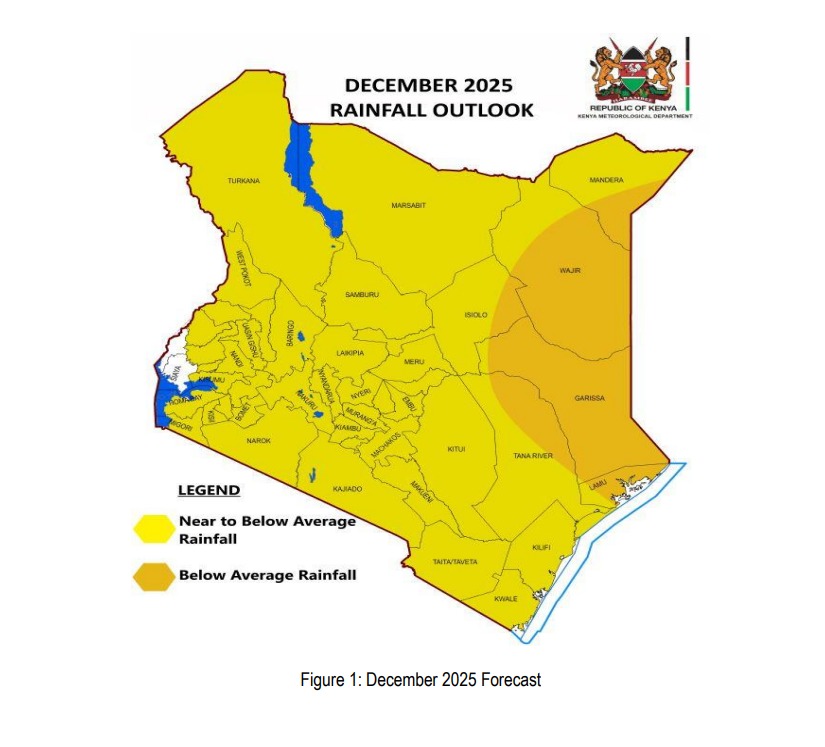
Kenya Meteorological Department says the country will remain dry in December that also marks the end of the October–November–December (OND) “short rains” season in Kenya.
The Kenya Meteorological Department in the forecast indicates that, the northern half of the country is likely to receive occasional rainfall at the beginning of December, followed by generally dry conditions for the remainder of December, January, and February.
“Temperatures are expected to be warmer than average across the entire country,” says the Acting Director of Meteorological Service, Edward Muriuki in the monthly forecast.
The Weatherman says that the next three months could also see most parts of the country generally sunny and dry in January and February, “with occasional rainfall expected primarily in December, especially in the southern part of the country,”
Some parts of the country, the Lake Victoria Basin, Highlands West and East of the Rift Valley including Nairobi county, the South Rift Valley, southeastern lowlands, and the coastal region, may experience a few rainy days in January and February.
According to the Weatherman the depressed rainfall and the ongoing drier conditions is due to, La Niña conditions which is currently underway, “with cooler-than-normal ocean temperatures being experienced across the central and east-central Pacific, which are expected to continue through December 2025 to February 2026,” says Muriuki in the statement and adds, “The negative Indian Ocean Dipole (IOD) is still active, but it has been getting weaker over the past three weeks.”
Reduced rainfall may lead to lower water levels in rivers, dams, and reservoirs nationwide, particularly in Arid and Semi Arid Lands (ASAL) regions of the eastern and northern parts of the country. “Communities and water managers are advised to implement water-saving measures, prioritize domestic water supply, and monitor water storage facilities closely,” says Muriuki.
The Weatherman advises that, in areas expected to receive rainfall, communities are encouraged to practice water harvesting to supplement their water needs, while those in the North Eastern and the Coastal regions are urged to use the available water efficiently.
The weatherman is warning that lightning strikes are probable disasters in the areas in the Highlands west of the Rift Valley, including Kisii, Kisumu, Nandi, Kakamega, and Narok Counties, as well as on Mt. Elgon and its surrounding areas, hence the need to take precaution. He is advising the public that despite the generally dry conditions, “isolated heavy rainfall may occur, causing localized flooding, especially in poorly drained urban centers and along the riparian areas, and the public is advised not to drive or walk through flooded areas to avoid loss of life.”
The anticipated near-to below-average rainfall in the ASALs is likely to reduce soil moisture, affecting crop growth and pasture availability. The depressed rainfall coupled with poor spatial and temporal distribution, may negatively affect crop production, over most parts of the Central and Eastern sectors of the country, including the Coastal region. In the ASAL areas of the Northeast and parts of the Southeast, the limited rainfall may hinder pasture regeneration, potentially leading to reduced livestock production.
“Farmers are advised to implement water conservation practices such as mulching, and monitor soil moisture closely,” says Muriuki and adds, “Livestock producers should prepare for potential water and fodder shortages, hence the need to store feed and ensure water points are well-maintained.”