
By Judith Akolo
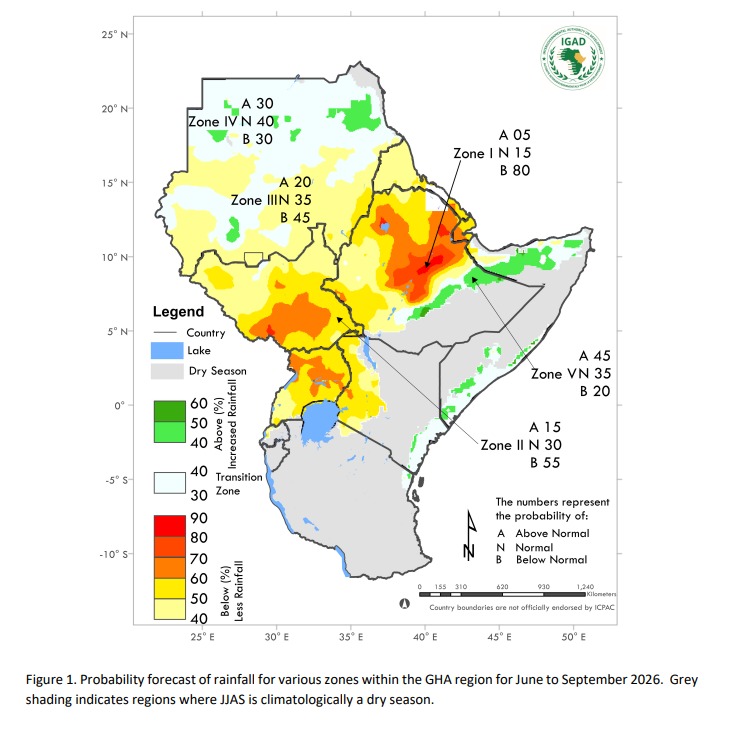
The June to September (JJAS) 2026 rainfall outlook indicates a high likelihood of below-normal rainfall across most parts of the Greater Horn of Africa, where JJAS is the main season.
According to the seasonal climate outlook forecast released by the Igad Climate Prediction and Applications Center (ICPAC), the areas to be affected include, South Sudan, Uganda, Ethiopia, Djibouti, much of Eritrea, Sudan and western and coastal Kenya.
“There are high chances for below-normal rainfall over central, north Eastern and north Western Ethiopia, southern Sudan and northern Uganda where probabilities exceed 60% over substantive areas, with peaks to 80% in Ethiopia and South Sudan.
They note that implications for the below normal rainfall across key sectors that are likely to be impacted include, agriculture, water availability, livestock systems, hydropower generation, food security, conflict, and public health. “Stakeholders are therefore encouraged to utilise the forecast information and advisories to support early action, risk reduction, and climate-informed planning,” say the climate scientists who met in Addis Ababa, Ethiopia at the 73rd Greater Horn of Africa Climate Outlook Forum (GHACOF73).
According to the climate scientists who met under the theme: Climate Services for Resilience and Sustainable Development with a Sub-theme: Enhancing Early Warning and Anticipatory Action for Climate Extremes in the Greater Horn of Africa, said areas including northern Sudan, southern coastal Somalia and Kenya are expected to receive near-normal rainfall.
The forecast indicates an enhanced likelihood of a late onset in parts of South Sudan, Ethiopia and southern Sudan. In contrast, a few localised areas, particularly over north-central Ethiopia and parts of central Sudan, are expected to experience near normal to earlier-than-normal onset.
The climate scientists who met in Addis Ababa, Ethiopia at the 73rd Greater Horn of Africa Climate Outlook forum further warn that, the evolving 2026 climate conditions “closely resemble those experienced during the strong El Niño years of 1997 and 2023.”
The World Meteorological Organisation (WMO) and major global producing centres also indicate that “El Niño conditions will develop rapidly and be active throughout the June, July, August to September (JJAS) season and will strengthen as the season progresses,” at the same time, the Indian Ocean Dipole (IOD) is currently in a neutral state, following the weakening of earlier negative conditions, “but will shift towards a positive IOD phase beginning next month to July and is expected to develop in concert with the strengthening El Niño event.”
The IGAD Deputy Executive Secretary Mohamed Abdi Ware is calling for the need to translate climate information into timely action and preparedness measures across the region. “Across the region, we are increasingly shifting the conversation from ‘early warning’ to ‘early warning linked to anticipatory action,’ recognising that climate information must ultimately support action and preparedness to make a difference.”
Fetene Teshome, Director General of the Ethiopian Meteorological Institute, called for sustained investment in climate services and regional cooperation to strengthen resilience across the Greater Horn of Africa. “We must continue to invest in and expand systems capable of generating knowledge-based, user-tailored climate information at both the national and regional levels,” he said.
The temperature outlook indicates a higher likelihood of above-normal temperatures across most parts of the Greater Horn of Africa. The highest probabilities of warmer-than-normal conditions are indicated over northern Sudan, most parts of South Sudan, and Ethiopia. The forecast points to a dominant warmer-than-usual season, with very low chances of below-normal temperatures across the region.