
By Samwel Doe Ouma
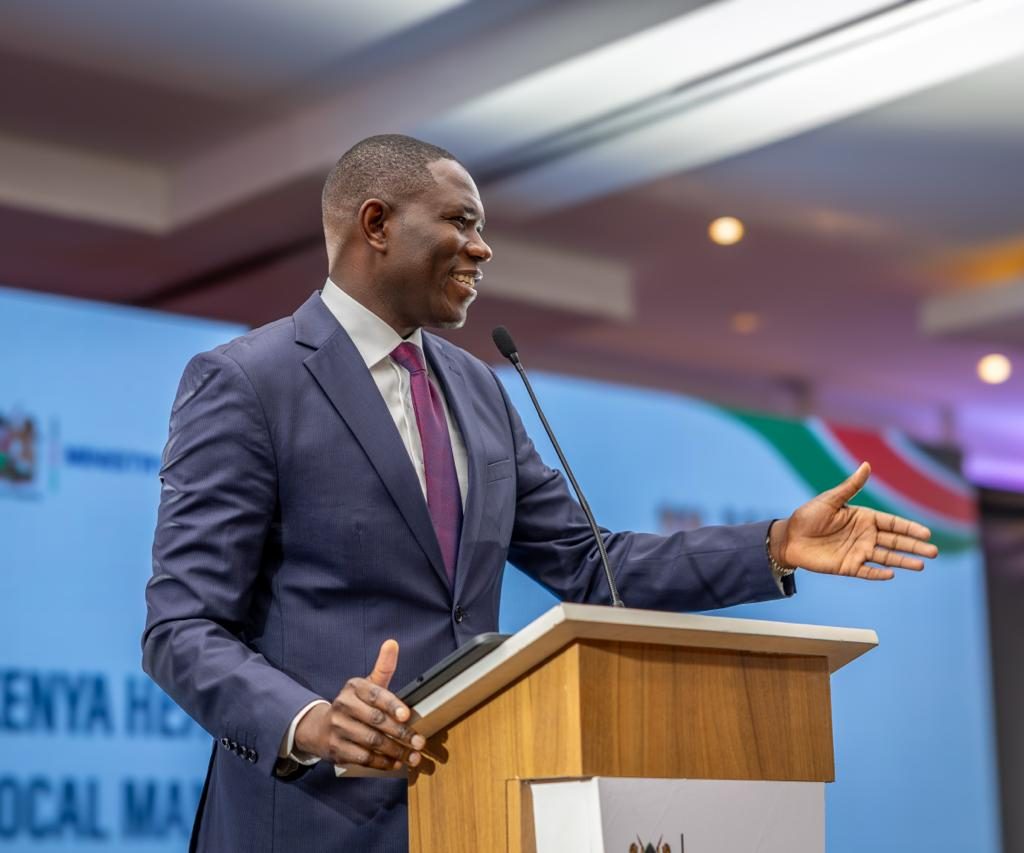
Kenya is accelerating plans to localize production of medicines, vaccines and diagnostics in a bid to reduce reliance on imports and strengthen health security, as officials warn that heavy dependence on external suppliers has left the country exposed to global shocks and rising costs.
Launching the Kenya Health Products and Technologies Local Manufacturing Strategy 2026–2030 in Nairobi on Tuesday, Dr Ouma Oluga, Permanent Secretary Medical Services, Ministry of Health, representing the Health Cabinet Secretary Aden Duale, said that the government will deploy concessional financing, pooled procurement and closer links between research and industry to build domestic capacity and cut import dependence that he said is no longer sustainable.
Kenya currently imports an estimated 70percent to 80percent of its pharmaceuticals and relies almost entirely on external sources for vaccines, according to officials and development partners present at the launch. The country’s health products market is valued at about $1.2 billion annually, with more than $760 million spent on imports, Oluga said.
“Local manufacturing is the single largest lever we have left to pull on cost, on access and on resilience,” Oluga said, adding that “you cannot finance a health system that you cannot supply.”
The push marks one of the clearest signals yet that President William Ruto’s administration is elevating pharmaceutical production to a core pillar of its universal health coverage agenda under Taifa Care, alongside broader reforms in health financing and primary care delivery.
The strategy has been shaped by lessons from the Covid-19 pandemic and subsequent outbreaks, including mpox, which exposed how quickly global supply chains can tighten during crises. The government now frames local production not only as an industrial policy goal but as a national security imperative.
That view was reinforced by the World Health Organization, which cautioned that import dependence can quickly become a structural vulnerability.
“In ordinary times, that dependence may appear manageable. But during a crisis, it becomes a vulnerability,” said Dr. Boston Zimba, WHO’s officer in charge in Kenya, speaking at the launch.
Dr. Zimba added, “When global supply chains are disrupted, access to medicines, diagnostics, vaccines and other essential health products can no longer be taken for granted.”
Kenya’s health system spends heavily on pharmaceuticals, which account for about 40percent of costs at primary care level and more than 20percent at tertiary facilities, according to government estimates. Yet domestic production remains limited, leaving the system exposed to currency fluctuations, shipping delays and external shortages.
The new strategy attempts to address those constraints through three linked interventions, financing, innovation-to-production pipelines and demand consolidation.
On financing, the government plans to establish a credit guarantee mechanism with the National Treasury and the Kenya Development Corporation to reduce risk for lenders financing long-horizon pharmaceutical and vaccine projects. It is also seeking blended financing from institutions including Afreximbank, the African Development Bank and the International Finance Corporation to support capital-intensive biomanufacturing investments.
Dr. Oluga reiterated that predictable, government-backed demand will be critical to unlocking private capital in a sector where payback periods are long and upfront costs are high.
He said that second pillar targets a persistent gap between research output and commercial production. Kenya has a strong health research base anchored by institutions such as the Kenya Medical Research Institute and the Kenya Institute for Primate Research, alongside university laboratories, but struggles to translate discoveries into scalable products.
Dr. Oluga said the government plans to strengthen “translational infrastructure” linking laboratories to manufacturing floors, including bioprocessing facilities and applied research hubs intended to support scale-up, formulation and commercialization. The approach is also expected to strengthen state-backed vaccine producer Kenya BioVax, which officials want to evolve beyond fill-and-finish operations into broader biologics capability over time.
“The third and potentially most consequential reform is on procurement. Kenya’s health purchasing is fragmented across national agencies, 47 county governments, faith-based providers and private buyers, creating inconsistent demand signals that deter large-scale investment.”
To address this, the government plans to shift toward pooled procurement and multi-year purchasing commitments, with the Kenya Medical Supplies Authority expected to play a central coordinating role. The model is designed to give manufacturers clearer visibility of future demand, reducing risk and improving access to finance.
“No manufacturer will build a factory for uncertain, competing buyers,” Oluga said. “They will build for one certain, aggregated demand signal.”
The strategy also introduces the concept of advance market commitments for locally produced medicines, diagnostics and vaccines, effectively using public procurement guarantees to anchor private investment decisions.
WHO officials welcomed the policy shift but warned that scale must not come at the expense of quality. Dr. Zimba said success would depend on whether Kenya can ensure consistent regulatory oversight and adherence to global standards.
“As Kenya expands local manufacturing, quality must remain at the centre of every step of the journey,” he said, noting that production capacity and regulatory systems must advance in parallel. The WHO said it would continue supporting Kenya alongside the Pharmacy and Poisons Board to strengthen oversight and quality assurance.
That emphasis reflects a broader continental challenge. Many African countries are seeking to expand pharmaceutical production, but face gaps in regulatory capacity, technical expertise and technology transfer, particularly in vaccines and biologics, which require high levels of specialization and sustained investment.
Kenya is positioning itself to compete within a wider African market, aligning its strategy with the African Union target of producing 60percent of the continent’s health commodities locally by 2040. President William Ruto has championed the agenda at regional level, arguing that scale through the East African Community and the African Continental Free Trade Area will be essential to making manufacturing commercially viable.
PATH, a global health organization working with the government on implementation design, said local manufacturing has shifted from policy aspiration to public health necessity.
“Local manufacturing is not just an industrial ambition; it is a public health imperative,” said Carolyne Njuguna, country director for PATH Kenya and East Africa, during remarks at the launch.
She said the strategy aligns with Kenya’s Vision 2030 and the Bottom-Up Economic Transformation Agenda, and could strengthen preparedness, affordability and access if fully implemented.
Still, the government faces familiar constraints, including high financing costs, delayed public payments, competition from cheaper imports and uneven enforcement of procurement rules. Vaccine manufacturing in particular remains capital-intensive and technically complex, often requiring long-term technology transfer agreements and sustained state support.
PS Oluga signaled confidence that the policy shift is overdue. Rather than treating constraints as barriers, the strategy frames them as problems of coordination and scale that can be resolved through policy alignment and pooled demand.
The measure of success, WHO’s Zimba said, will not be the number of facilities built, but whether the system delivers reliable supply.
“The strategy will ultimately be judged not by the document itself,” he said, “but by the factories that expand production, the medicines that become more accessible, and the lives that are improved.”