
By Judith Akolo
The Weatherman is warning of insufficient rainfall expected during the short rains season of October, November to December and is urging for smart ways in the utilisation of water and pasture in the Arid and Semi-Arid regions of the country.
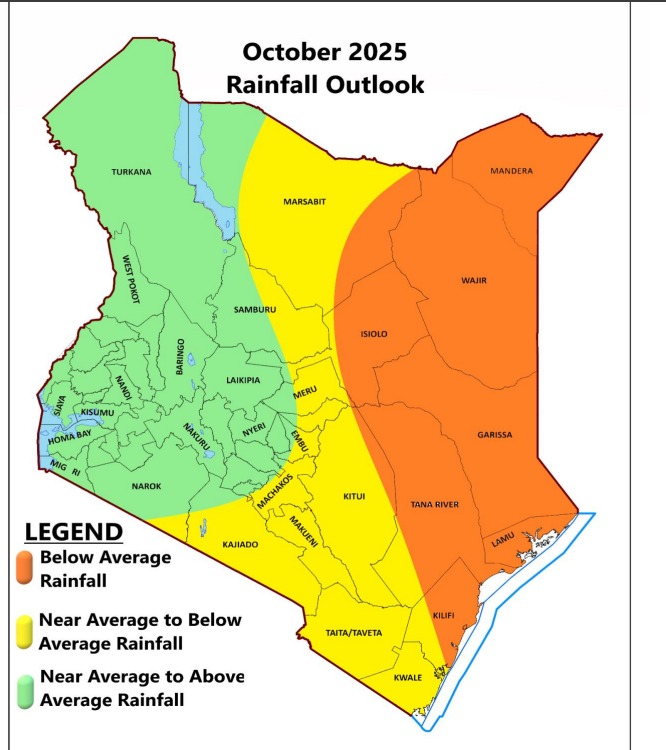
In the monthly forecast released by the Kenya Meteorological Department, the season which compares to the 2021 short rains season is expected to experience dry conditions in most parts of the country except for the Western part of the country and parts of the Lake Victoria Basin.
The weatherman is attributing the below-average rainfall across the country, to “mainly due to the models’ prediction of a negative Indian Ocean Dipole (IOD) and the anticipated development of a La Niña event during the OND season,” says the Deputy Director of Meteorological Service Charles Muga.
The Weatherman explains that, consistent with the July and August forecasts, the latest projections continue to indicate a high likelihood of below-average short rains across Kenya in 2025, especially in the ASAL regions.
“The forecast probabilities for both mild and severe droughts have decreased slightly across the country,” says the statement and adds, “but they remain significantly high over the eastern half of the country,” and further warn that the expected rainfall deficit is likely to exceed the thresholds for both alert and alarm worsening drought phases.
According to the Standardized Precipitation Index (SPI) forecast, the counties with the highest likelihood of experiencing severe drought include Mandera, Garissa, Wajir, Samburu, Tana River, Tharaka Nithi, Kitui, Makueni, Machakos, Taita Taveta, Kajiado, Kwale, Kilifi, and Lamu.
However, the forecast indicates that the Highlands west of the Rift Valley, the Lake Victoria Basin, the Central and South Rift Valley, the Northwest, most parts of the Highlands east of the Rift Valley (including Nairobi County), and isolated areas in Marsabit are likely to experience near to above-average rainfall.
The public is being urged to take advantage of the favorable conditions to plant trees towards the realization of growing 15 billion trees and restore degraded landscapes by 2032.
“In contrast, most of the Southeastern lowlands, the southern Coast, a few areas of the Highlands east of the Rift Valley, and isolated areas of the Northeast are expected to receive near to below-average rainfall. The rest of the Northeast and much of the Coastal region are likely to experience below-average rainfall,” says that Weatherman.
The expected near to above average rainfall in the Highlands West of the Rift Valley, Central and North Rift Valley is likely to provide sufficient soil moisture to sustain agricultural production. “The rains are however likely to disrupt harvesting of crops in areas that are ongoing with harvesting,” says Muga.
He further warns that the continuation of sunny and dry weather conditions in the Northeast counties and Southeastern Lowlands may lead to diminishing pastures and water for livestock in these regions, hence the need for close monitoring of the situation.
There is a possibility of lightning strikes in Kisii, Kisumu, Nandi, Kakamega and Bungoma counties around the Mt.Elgon areas as the area is expected to receive near to above average rainfall.
The Weatherman notes that with the major river catchment areas that supply the country’s hydroelectric power dams forecast to receive near to above-average rainfall, hydropower generation will not be affected, however he is urging the public to undertake water harvesting in the Arid and Semi-Arid Lands so as to maximize the utilization of rainwater.