
By: Deborah Cheloti
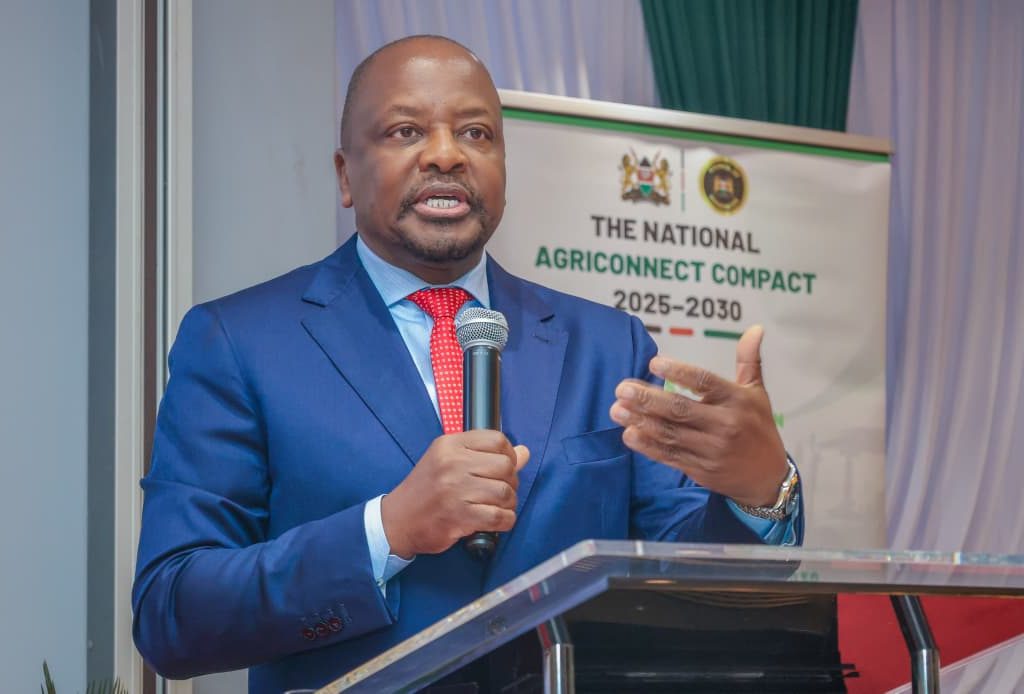
Cabinet Secretary for Agriculture and Livestock development has unveiled Kenya’s Agriconnect Compact 2025-2030 in Nairobi to transform the sector from subsistence farming to a modern high tech and commercially viable economic power house.
Kenya has officially fired the starting gun on a massive, market-driven overhaul of its agricultural sector.
According to Cabinet Secretary Mutahi Kagwe AgriConnect Compact positions agriculture as a modern, technology-enabled, climate-smart and investment-ready engine, for inclusive economic transformation.
a bold national agricultural transformation initiative that was engineered to shift the sector away from subsistence farming and pivot the nation toward a modern, high-tech and commercially viable economic powerhouse.
This strategy targets the root inefficiencies of the country's food systems, specifically focusing on fragmented value chains, crippling post-harvest losses and a very high reliance on costly food imports.
The core philosophy of the framework views agriculture not as a default survival mechanism, but as a sophisticated financial driver. During the high-profile launch, CS Mutahi Kagwe stated that the.
“the Agriconnect Compact is a deliberate, strategic, and urgent framework to align public investment with private sector ambition where public investment finances foundational systems and public goods, reducing risks and creating an enabling environment that attracts large-scale private capital," CS Kagwe said.
Agriconnect Compact emphasizes on digitalization and technology which will see the deployment of digital extension services, agritech platforms for market traceability and advanced processing technologies which have been designed to eliminate crippling post-harvest losses.
Rather than relying solely on limited state coffers or international donor grants, the framework utilizes a strategic public-private blended finance model designed to fundamentally change the risk profile of agricultural lending. To fuel this transition, the government is committing USD 3.8 billion in catalytic public funds.
According to CS Kagwe the massive state backing is structurally engineered to finance foundational systems and public goods, thereby reducing risks and creating an enabling environment that effectively "crowds in" a massive USD 7.6 billion in private sector investment.
“The financial architecture of the five-year plan marks a distinct shift in how large-scale development programs are funded in East Africa.”
Explaining this deliberate synergy, CS Kagwe noted that the initiative is an urgent framework to align public investment with private sector ambition.
“By leveraging public-private partnerships and credit guarantees, the framework turns traditionally high-risk local value chains, such as dairy, edible oils and horticulture, into highly attractive, lucrative targets for private capital.”
Agriconnect Compact strategic roadmap will rely on a heavy injection of technology and targeted market overhauls.
The initiative prioritizes digitalization by deploying digital extension services to rural farmers and launching advanced agritech platforms for market traceability.
CS Kagwe said that the efforts will be paired with modern processing technologies specifically designed to stop post-harvest waste before it reaches the market.
He added that, beyond production, the framework will overhaul market systems by upgrading physical logistics infrastructure, rolling out digital marketplaces, and developing structured trading systems to ensure farmers are no longer exploited by middlemen and fragmented value chains.
“These sweeping market reforms are attached to hard macroeconomic targets. By formalizing and protecting these networks, the state aggressively targets a 50 percent reduction in the costly import of vital food staples like rice and maize.”
Simultaneously, he said , the framework is designed to drive a 60 percent surge in high-value agricultural exports destined for global markets.
“Most importantly, this market-driven growth is directly tied to solving the nation's pressing youth employment crisis. The AgriConnect Compact is uniquely engineered to create 2.482 million new and upgraded better jobs by 2030.”
He added that, the innitiative rather than pushing youth toward traditional, manual field labor, these roles aim to absorb the younger generation into dignified, modernized positions across agro-processing, logistics, digital supply chains and corporate agribusiness management.
Highlighting the deep human impact of this shift, CS Kagwe emphasized that the jobs to be created will be real jobs with dignity, adding that the food security achieved will mean that no Kenyan goes to bed hungry.
The launch underscored a powerful, unified front across both tiers of government and the international community. Backed by strong political will, the National Treasury and the Council of Governors, the extensive technical groundwork is officially complete.
The high-level rollout drew an immense coalition of prominent local leaders and global partners, including State Department leadership represented by PS Livestock Development Jonathan Mueke and PS Agriculture Dr. Kipronoh Ronoh. County governments, represented by Governors Mutahi Kahiga of Nyeri, Nathif Jama Adam of Garissa, Joseph Ole Lenku of Kajiado and Kisumu County Deputy Governor Dr. Mathew Ochieng.
The global development and diplomatic community also pledged heavy alignment, with key representation from the World Bank Group, the International Fund for Agricultural Development (IFAD), the African Development Bank, the Gates Foundation, and AGRA. Diplomatic backing was anchored by the embassies of the United States, Germany via GIZ, and the Netherlands.
Crucially, the private sector voice was reinforced by major industry bodies, including the American Chamber of Commerce, the British Chamber of Commerce and Industry, the Kenya Private Sector Alliance (KEPSA), the Kenya Association of Manufacturers (KAM) and the Agriculture Sector Network (ASNET).
With the policies written and the coalition assembled, Kenya is officially moving from strategy to collective action to secure total food sustainability and widespread economic prosperity.